Showing posts with label regional cuisine. Show all posts

Friday, 1 June 2012

5 "Strange" Portuguese Foods that I've Grown to Love (And Think You Should Try Too)

Percebes (Gooseneck Barnacles)

*Interested in learning more about Portuguese food and wine with me? Check out my An American In Portugal Tours, and my blog's new home!*

I wouldn't say there are many "strange" things in Portuguese cuisine.  And by strange, I mean something that isn't normally found or eaten in your own native country.  In general, I actually find Portuguese cuisine to be one of the most "likeable" cuisines, because just as in the much-loved Italian cuisine, they use a lot of simple, fresh, locally sourced ingredients.  And for the most part, every dish that has been put in front of me during my time in Portugal has looked delicious and made me instantly want to eat it.   

However, there have been a small handful of Portuguese foods and dishes that I definitely found, and still think are strange.  And it's even more difficult for someone like me with a culinary background to get weirded out by something.  But these were foods that I either never knew existed or the combination did not look appetizing.  Though ironically, they are some of the most nationally known and loved foods in Portugal!  But since my parents raised me with the good manners of eating everything on my plate, even if I didn't like it, I knew I had to try these things regardless of what I thought.  

Though now I'm glad I did, because then I understood why these foods are so popular here- they are indeed, really tasty!  Granted, the soft texture of these foods in particular was not very appealing to me at first, but once I stopped focusing on that and more on how delicious they tasted, I was able to let go and truly enjoy and appreciate what I was eating.  

It's true, we're all programmed to turn up our nose at things that look strange or unappetizing to us, it's natural.  Would you believe that most Portuguese I've asked have never even heard of the classic American peanut-butter and jelly sandwich?  And even funnier is that after I explained what it is, most of them still found it strange and and wouldn't want to try it! :)  The same way they found it funny and surprising when they heard my reaction to their beloved foods.   So bottom line, if we get over these cultural or personal hangups, as I eventually did, we'll be able to enjoy so many more things that one would have never imagined to be delicious! 

Below are five popular Portuguese foods and dishes that I found very strange in the beginning but now love.  I've ordered them on a scale of "least to most strange" :)  So, on your next trip here, I encourage you all to give these foods a chance and try them like I did, as you never know just what might become your next favorite food!

Açorda (Alentejana)- "Bread Soup":

Açorda Alentejana (Bread Soup) Photo by As Minhas Receitas

Açorda de Gambas (Shrimp) Photo by: Sabores da Alma


The only bread I normally associate with soup are the croutons you sprinkle on top, so when I found out that bread was the main ingredient of this traditional Portuguese main dish, my first question was "why?"  Well, with the historically poor background of rural areas, one had to make sure you never wasted anything, so this was a way to use up old, stale bread.  Traditionally, the bread is soaked to some degree of softness, then either broken up and/or cooked with chopped garlic and fresh cilantro.  

There are two main versions of açorda. In the greater Lisbon and northern regions, they make Açorda de Gambas, where the bread is heavily soaked and mushed up, then cooked with shrimp Despite its great flavor, I'm not a big fan of this version (pictured second) because the look and texture reminds me too much of...er...vomit .  But I do love the Açorda Alentejana version (pictured first), which resembles more of a soup without cooking the bread.  Only a hot broth of garlic, olive oil and tons of fresh cilantro is poured over it and topped with a poached egg.  Many people also add bacalhau (saltcod) or other fish to it for a heartier meal.   Açorda Alentejana is so popular here that it was nominated as one of the 7 Maravilhas da Gastronomia (7 Wonders of Gastronomy-hmm a future post?) and even though it didn't win, you don't want miss out on trying this!

Sapateira Recheada-Stuffed Stone Crab:
Sapateira Recheada-(Stuffed Stone Crab) Photo by Papo Cheio

Let's get this straight- I love stone crab, in fact I loved it even before I moved to Portugal.  But I never had anything more than the claws, which can sometimes cost you a small fortune to get in the US.  Here in Portugal though, on the coast, sapateira is about as common and readily available as any regular fish, and much more affordable!  But get ready to eat the whole thing, which includes the shell of the body stuffed with its roe and insides.  Yes I know what you're thinking, that really doesn't sound lovely, and I made a face too when I saw it the first time.....but oh my god is it delicious!!!  This has become my favorite part of the stone crab now, because the flavor is so rich compared to the claws and legs, and when spread over some warm toasted bread and butter it's just heavenly :)  Personally I prefer this stone crab stuffing plain, but most people mix it with a variation of the typical ingredients found in a classic potato salad, like mustard, mayo, pickles, egg, onion, parsley etc, even beer!

You can find sapateira recheada on the menu of any marisqueira-seafood restaurant, all along the coast, but note: it's a common belief here that stone crab and most shellfish are only best eaten "in the months with an 'r'" (September-April) so try to save this for a treat in the colder months.  And if you're a seafood lover in general and want to know more about sapateira and other shellfish as well as one of my favorite spots to eat them, check out my past Catavino article- "Sesimbra: A Seafood Lover's Paradise in Portugal"


Ovas-Fish egg sacs:
Salada de Ovas (Fish Egg Roe)- Photo by Cinco Quartos de Laranja,-also available in English
These not-so-luxurious fish eggs typically come from pescada (hake) or bacalhau (saltcod) and honestly, if you saw these whole- raw or cooked, they look absolutely disgusting.  But when sliced up and made into a cold salad mixed with onion, tomato, bell peppers, olive oil, vinegar and fresh cilantro (as pictured above), they are much more pleasing to the eye and very tasty.  Many Portuguese also recommend eating plain, boiled ovas when you're sick, particularly if you have tummy problems, because they are mild and easy to digest.  You can find salada de ovas served at many fish and seafood restaurants as an entrada-appetizer.


Caracois- Portuguese Snails:
Caracois (Snails)
Snails, either you love em' or hate em', but most Portuguese absolutely love this seasonal late spring/summertime bar munchie.  Unlike the French escargots, caracois à portuguesa are much smaller- normally about the size of a dime and are slow-cooked in a delicious broth of olive oil, garlic, onion, oregano, bay leaf, salt and pepper and sometimes a pinch of piri-piri for a slight kick.  They are best enjoyed with a cold glass of Portuguese draft beer and a basket of bread to mop up all of that finger-licking broth mmmm :)  You can read all about my first experience with caracois and more on the Catavino Article I did about them- "Suck it Up and do What the Portuguese do, Eat Caracois!"

Percebes- Gooseneck Barnacles:
Percebes (Gooseneck Barnacles)
Utterly strange, not even edible looking and more expensive than most seafood....who in their right mind would want to eat these things??  Yup, exactly what I said at first, but plenty of people eat them here, including me now!  Goose or goose-neck barnacles can be found growing on the rocky cliffs all along the northwest Atlantic coast but are most appreciated in Spain and Portugal.   Due to the dangerous area they grow in, they are a lot of trouble to collect- hence the hefty price.  Just a tiny appetizer plate of them at your local marisqueira here can cost around €8-10.  And they're not that easy to eat either, since you have to take off the rubbery outer layer first, which can get a bit messy as you might get squirted by their red juice if you're not too careful!  You can check out exactly how percebes are harvested and eaten in the video below from Gordon Ramsay's show The F Word, when he went to Galicia, Spain (just above the northern border of Portugal) and you'll see that he agrees with me that although percebes look totally unappetizing, they really are delicious.  In my opinion, I would describe them as having the cleanest, most pure, unadulterated flavor of the ocean- refreshing! 


Happy Adventurous Eating in Portugal! :)

Friday, 27 April 2012

Peixe em Lisboa "Lisbon Fish & Flavors"-A Portuguese Gastronomic Event That Deserves More

Red Fish w/ lemony green rissotto from 100 Maneiras
-photo by Rochelle Ramos
*Interested in learning more about Portuguese food and wine with me? Check out my An American In Portugal Tours, and my blog's new home!*

Last Saturday, I spent the afternoon at the 4th annual Peixe em Lisboa or "Lisbon Fish & Flavors", which claims to be the "Most Significant Annual Gastronomic Event in Portugal", predominately showcasing the abundant fish and seafood of Portugal's coastline.  The 10-day event organized by Turismo de Lisboa was held inside the elegant Pátio da Galé, within the grandiose Praça do Comércio in downtown, right on the river.  Inside, they had a dining area featuring ten of some of the most popular fine-dining restaurants and chefs in Lisbon and the greater Lisbon area, serving up their own, fish-themed mini-menus as well as doing specialty show cooking and demos throughout the week.   Along with this, an adjacent room had several local gourmet vendors and wineries offering small tastings of their products available for purchase. 

Peixe em Lisboa through the eyes of a
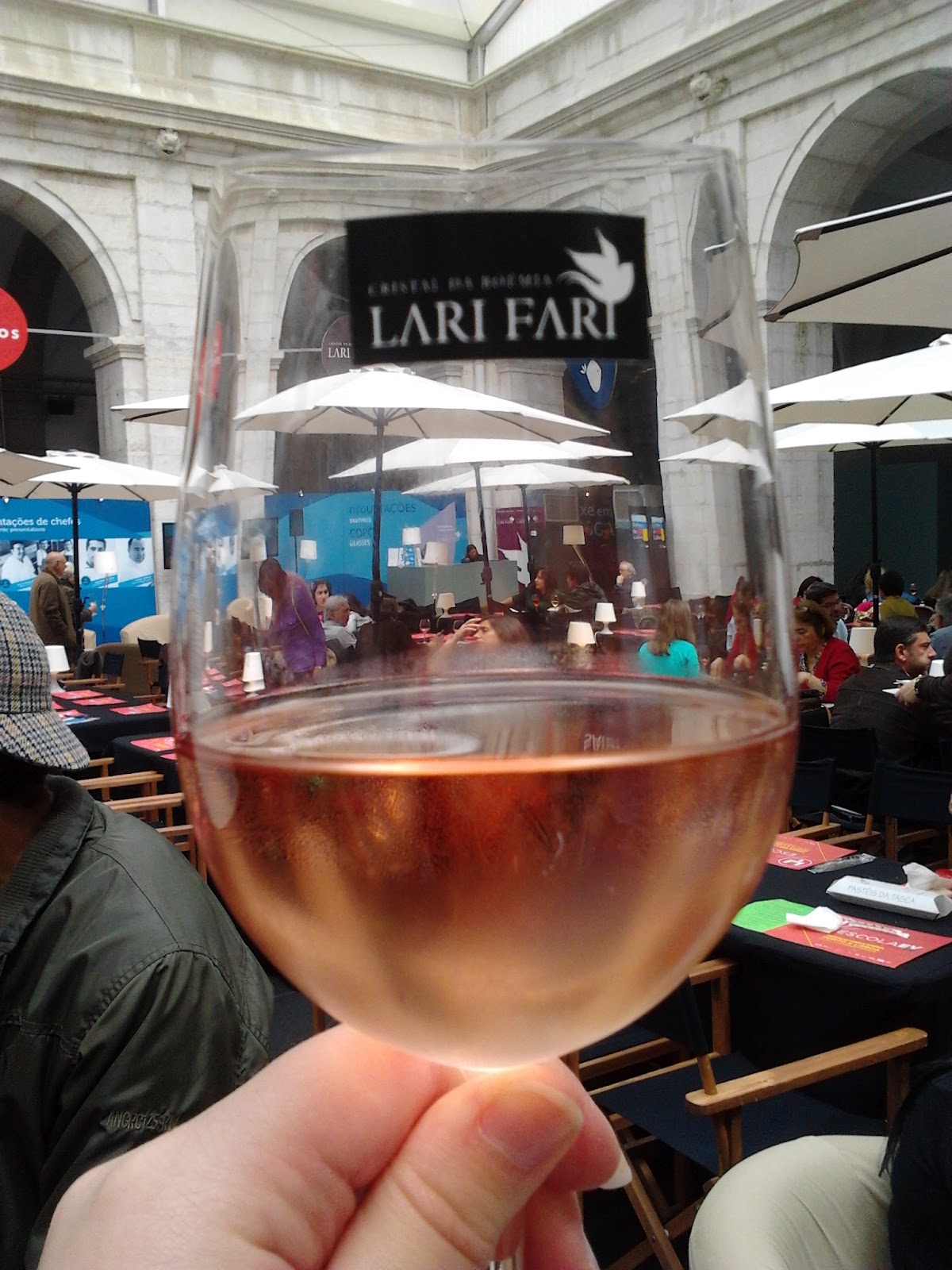
Moscatel Roxo Rosé from José Maria da Fonseca
I have to be honest, I wasn't planning on going to this event in the beginning.  For the past 4 years, I have gone to several Portuguese food and wine expositions around Lisbon and Porto and have left quite disappointed by their poor presentation and disorganization and I figured this one would be no different.  But after my fellow "Expat Reporterette" and Lisbon tour guide, Mary Harrison Goudie convinced me and our "Fabulous Food Photographer" expat Rochelle Ramos that this was worth our time, we decided to arm ourselves with our cameras, microphones and social media and hit Peixe em Lisboa ready for some serious wining, dining and picture snapping. 

Thankfully, Mary ended up being right in many aspects.  The quality of food and wine we tasted at the event was amazing, and definitely made me wish that I had come on other days to experience all the different tastings and demos they had to offer.  We managed to try around 3 plates each from 3 of the participating restaurants, with either the chef or one of the cooks surprisingly agreeing to step away from their kitchen for an interview with us to talk about their restaurant and each of the plates we were trying.  

Bacalhau á Bras with Exploding Olives from José Avillez
-photo by Rochelle Ramos
Our first and I think by far, our "fan favorite" was José Avillez, whose simple, straightforward dishes were truly delicious.  I absolutely loved his richer, creamier version of the traditional Portuguese dish, Bacalhau á Bras -shredded saltcod mixed with potatoes, onions and garnished with olives, which in this case, happened to be green olives filled with tart olive juice that "exploded" in your mouth, a nice twist!  José Avillez was also one of the friendliest chefs I've ever met, he came right up to us to say hello from the very beginning and after the interview he returned several times to ask us what we thought of the dishes.  And not only was he friendly with us, but we watched him stand in front of his kitchen greeting and talking to guests waiting in line, always with a smile on his face.  Later on, when my sweet tooth got the best of me, Chef Avillez suggested we try his favorite dessert creation, Avelã or Hazelnut, which was hazelnut gelatto encased in fluffy whipped hazelnut mousse topped with Portuguese fleur de sal.  I have one word for it: divine :)

Seared Azorean tuna from José Avillez
-photo by Rochelle Ramos
Sapateira (stone crab) "sliders" from José Avillez
-photo by Rochelle Ramos
Chef José Avillez chilling out and telling us about his dishes 
Another restaurant we enjoyed was 100 Maneiras, whose fried shrimp "lollipop" and red fish with lemony green rissotto pictured at the top were a hit among us.  And their passion fruit panna cotta with almonds for was a perfectly layered harmony of flavor and texture in my mouth, definitely giving Avillez's Avelã dessert a run for the money! 


João Simões, Executive Chef of Grupo 100 Maneiras holding 
his shrimp "lollipop"
Passion Fruit Panna Cotta with Almonds from 100 Maneiras
-photo by Rochelle Ramos
José Maria da Fonseca was the winery sponsor for the event and couldn't have done a better job from what I saw.  They had what looked to be almost all of their large selection of wines available to taste at their stand in the dining room, as well as offering specialty wine tastings and wine pairings with the cooking classes throughout the day.  All of their employees pouring the wines at the stand were very warm and friendly and happily answered any questions we had.  JMF winemaker Domingo Soares Franco was also great in leading the specialty tastings.    

We enjoyed two of their fish-friendly rosé wine recommendations to pair with our food tastings, the dry Periquita Rosé and uniquely fruitier Moscatel Roxo Rosé.  We then followed with their white DSF (Domingos Soares Franco) Colleção Privada Verdelho and finished with their fortified DSF Colleção Privada Moscatel de Setúbal for dessert.  At the DSF specialty tasting, I tried another 6 of their reds, 1 white and 3 more Moscatels, which all of them I liked but I have to say my two favorites were the 2008 Pasamados white, a nutty-buttery blend of Viognier with native Arinto, Esgana and Visozinho varietals and the 2008 José de Sousa Mayor red, a smooth, richly fruity blend of Trincadeira, Aragonez and Grand Noir.
Periquita Rosé from José Maria da Fonseca
-photo by Rochelle Ramos
Overall, my experience at Peixe em Lisboa led me to believe that this is an event worth keeping around.  But this is also an event that's worth more than the still somewhat lackadaisical organization and marketing that I saw there.  After reading Celia Pedroso's review of the event, I agree that for something organized by Turismo de Lisboa, having only 8% of the attendees being tourists is a shame, they definitely need to market more to them!  And the dining area definitely needs to be bigger, investing in those handy mini-trays that hold your wine glass and food would also be a good idea in case you have to stand.  The location was perfect for tourists, except for the fact that they made the entrance on the side street instead of facing the plaza, where the exit was instead.....how does this make any sense?  And the official website's half-decent English translation (I'd be happy to help with this!), had no icon on the homepage to access the English version, so that could have deterred foreigners from coming as well.

But the biggest issue I had with Peixe em Lisboa was the ticket pricing and offering.  It was the typical European "á la carte" pricing, one of the things that had always annoyed me at previous food and wine expositions here.  You pay a moderate price to enter, but get limited access to most of the event and the rest is extra.  Tell me, isn't an exposition supposed to be about exposing and gaining awareness of your product or service to new clients rather than just trying to make money off of them?  This year, Peixe em Lisboa charged €15 per person for a 1-day ticket, which entitled you to a wine glass and just one "€5 food tasting" and one "€1.50 drink tasting", which I don't even know what that one was for since no one seemed to be charging for wine.  However, if you went during the weekday lunch hour from 12-3pm, your ticket got you two instead of one, which is still not much and most working people can't go at that time.   And even if you wanted to buy more, there was of course no convenient ATM in or around the venue to get cash.   I must say, all of this can sour a guest's mood quite quickly!

Let me put it this way, I come from the land of package deals, where you pay one price up front to access everything, which in my opinion has always been the more desirable option.  How about offer a ticket then that includes three food tastings instead of one, so guests can try an appetizer, main and dessert, then they can get the equivalent of a full meal if they're coming at a mealtime.  The ticket should also include access to the majority of the showcase events throughout the day (and provide more seating for these), only a couple of things should be reserved to purchase at an extra cost.  For all of this, you could charge around €25-30 instead of €15 and I would be happy to pay more up front if  that gave me access to the majority of the event.  You could even offer a discounted a multi-day ticket, to come for 2 or 3 days instead of one, which I would have loved since there were so many different events held each day throughout the 10-day exposition. 

So, Peixe em Lisboa, here's my suggestion for next year:  Give your guests more.  More options.  And then they'll realize you're worth it!

*Check out the rest of Rochelle's and Mary's photos of the event on our Pinterest Boards Peixe em Lisboa and Portuguese Food

Avelã (Hazelnut) dessert from José Avillez
-photo by Rochelle Ramos